[00:00:00] Tayson: Hey everybody, welcome back to the Live Ultralight Podcast part by Outdoor Vitals today. We have another Behind the Designs episode for you for a new fleece, hoodie, but this is I call it fleece but there's a lot more that's going into this piece so we really need to break it down because there's three different Fabrics. But I would say this is kind of like a part two to the Mountain Pursuit launch. We're launching two new products right. Now, a third product to come about a month and a half down the line. And we started with the Altura Dynamic Pants. So, if you missed that episode, you may want to go back and do that. Because we
[00:00:34] Tayson: didn't talk about some of the more like broad aspects of what we wanted to do in this line. But we'll try to cover it a little bit again here, but in this particular episode, we're going to talk about The initial idea of this hoodie, what we wanted to accomplish the R&D process behind it. And then, you know, what was built and how we feel like that performs and why we think it's such a an exciting piece. This is to me, this is a very, very exciting piece because, you know, in a world where you've got a lot of companies out there, always trying to innovate, it seems less common to have a piece that's like
[00:01:11] Tayson: the Phil's really, really unique. Um, but in my mind this is one of those pieces. This isn't like a let's improve it and do our take on it. It's like a there's really not much you know that that's built like this and used like this and so we I don't know. I'm really excited about it. I think you guys are really going to like this piece so This has been a piece that's been under development for. I would say this one easily, three years because we've we've been testing these fabrics and different configurations for more than three years. And so it's been a very long research and development process design process. But it's resulted in
[00:01:53] Tayson: a piece that is just really exceptional. So to back up just a little bit, we talked about in the last one that we, you know, we obviously were we were working on our own designs in this category. We had some friends of ours that owned a company called EXO Mountain Gear approach us and say, hey, we would love to work with you guys a little bit and give some feedback on design. Not a, there's no Financial partnership here. There's no affiliate program promotion like just true authentic. We just want to have some input on some apparel pieces and to just go through some of the R&D process with you guys and we're like, you know,
[00:02:36] Tayson: and it just really matched up. And we talked about in the last episode how these guys are mountain athletes. And so we we love it. Like, this is the stuff we do. This is the stuff our audience does. And so it's a great opportunity to use other people that design their products for their company. To also come in and give us Insight on on our R&D processes as well. I think the other cool thing about it that make that made it, make a lot of sense is that so, everything that you just said, plus these guys, they also have a podcast like us and they get
[00:03:12] Brigham: They do a lot of answering questions and providing recommendations to Their audience and that was kind of a part of why they wanted to kind of work with us and collaborate on this is is so that they could feel about what the so that they could feel good about what they're recommending when. They're Fielding questions. When somebody asks them what what do you recommend for this pant? Or this puffy or whatever it is that they you know, they wanted to provide a solid recommendation. That line with their battle line with their values and their performance requirements. So that was another cool element to how this how this all kind of has come in together.
[00:03:57] Tayson: We talked about this in different podcasts. Quite often about how we don't, like Venture Capital money. We don't go retail. We sell direct to consumer. And these guys, they feel the same way. They're they're, you know, they're family owned, they their direct to Consumer brand only but also They kind of gave their frustrations because they're they're sportsmen's, they're in the hunting world and they gave their frustrations about, like the brands in that category of the last 10 years have just constantly sold out to venture capitalists kind of this and Rand deterioration. Yeah, the values changed and so they're like, man. We used to love this and then they sold out and this changed and this
[00:04:38] Tayson: changed and, and, and so there's some frustration there for from them. And and it and like I said, we have, we share those similar values and so, we've been friends with them for a while. We've sent them prototypes, and things like that for for years now, but there's just not an opportunity to do something that would really Bridge, those worlds, a little bit more. We've talked about this on other. So it's tube, both me and Brigham are Sportsmen. I mean, I, I grew up hunting from this early as I can, possibly, remember hunting with my grandpa. You know, it's just something that has been a part of life for me, and it's one of the
[00:05:12] Tayson: ways that I truly enjoy nature, a lot of times. Like, sometimes we'll get a little bit of flack for me, like, you guys are out there doing like these 100 mile trails and you're just doing 20 mile plus days and you're not even seeing the country. Like that's like one side of how I enjoy nature. And other side is that I will literally backpack into a Wilderness and sit on a hill from up to sundown and just watch animals. Like, I just enjoy the heck out of doing that stuff. And so Anyways, that all being said, there is this crossover point where we use our gear for hunting all the time and have, and these
[00:05:42] Tayson: pieces will fall into some of those categories, but they also just fall into the category of you're not walking down, a graded, beautiful Trail, in the middle of summer, we're talking about pieces that are built to go down. Rough trails to go off Trail to be used in shoulder Seasons. Three season four season use to be used in high Alpine environments where weather changes on a dime. It goes from Sunny to a blizzard back to Sunny because those storms are just so intense. When you're up that high, these are pieces that are built for real real Mountain conditions, which is why they fall into what we call our Mountain Pursuit line. So if you're someone
[00:06:24] Tayson: who isn't just backpacking in the middle of summer, if you're someone who is going to go summiting peaks, backpacking and in the fall or the spring or the winter, Or just doesn't take the most graded, popular trails there are all the time. These products are going to be for you and we guess what, we have a ton of you guys out there. So our audience likes this, we like this. And so we're it was a fun opportunity to to get to work on this. Now this particular piece. Design intent around. This was interesting and I'll kind of again. I for those of you could literally listen to this podcast, you're likely customers or likely
[00:07:03] Tayson: know some things about us. So one of our best-selling products is our Ventus Active Hoodie. And that product is absolutely exceptional. It's got breathable face fabrics for what it is a really lightweight insulation piece. That is like warmer than you really give it credit. It's got an active insulation, the stretches and moves, it's got vents. But the thing about that piece is it's still is not like an open knit material. And when you are being really active, you can still overheat in that piece unless it's really cold temperatures. And and guess what? We're active a lot, and we're active year round, and so there was still a niche. placement for us that we thought there's
[00:07:47] Tayson: a piece. A mid-layer that we could build, that is a little bit more breathable, but it doesn't just like a fleece, right? Because the fleece jacket. Yes, it can insulate. Yes, it can keep you warm and do maybe some moisture management but the second the wind blows, it cuts straight through a fleece piece and you're back to being cold. And so there's there are some some areas here where we thought we had Some opportunity, I guess, you could say to build something that wasn't in our lineup already and really wasn't in anyone's lineup. So yeah.
Editor’s note: The Mountain Pursuit launch sequence, product lineup, collaboration, company-model comments, and Ventus comparisons describe Outdoor Vitals’ August 2025 context. They are historical design and business claims, not current availability, specifications, or future-product commitments.
[00:08:26] Tayson: As we getting started in this project. Brigham, what are you thinking that like, what's your end goal? Like, if we could build this Then we've accomplished the right. The right objective. Yeah
[00:08:36] Brigham: well I think. That. It's more based around like a condition set or a scenario. That is probably much more common than people would acknowledge or recognize. You know, you mentioned the Ventus. That's a synthetic insulator lofted insulation piece. That yeah, uses synthetic lofted insulation and it's, it's very warm for what it weighs. But it has in terms of being active and using it for extended periods of time. There's a huge opportunity there and that's kind of the condition set of, of where kind of what generated this piece for, for me, at least, is that? There are there's conditions. Meaning temperature related conditions, environmental conditions that. If you find yourself in, it's too cold for whatever
[00:09:41] Brigham: reason be that just the ambient temperature. Be that a temperature combined with a lot of wind or some precipitation where It's two. It's just too cold to hike. Just in your, your base layer or your sun, hoodie. So what do you wear? The. And, and if you're going to be moving for extended periods of time, and this is like when I say moving, I'm not talking running, I'm talking just just hiking so where you're generating enough body heat to to sweat. It can be cold enough that you need something besides that besides your base layer. Now we oftentimes have talked about the application of a windbreaker, which is a outstanding piece. It doesn't insulate at
[00:10:33] Brigham: all. It doesn't wick moisture doesn't manage moisture at all. It's it's intention is to just block wind and wind sucks, the heat away from our body. And and so but there are plenty of times where there's just a little bit of wind but the temperatures are cold again like I guess the the key here is like the temperatures are cold enough to Warrant something more than a base layer or a base layer with a with a windbreaker because you need warmth but breathability and so The for example, if we say well, why don't we just put on events to Hoodie? The answer is because it's too warm and not breathable enough and we would two
[00:11:14] Brigham: quickly overheat that system and overwhelm it. And then we are sub-optimal. We've now de-optimized our clothing system and so That's kind of the condition set where there's this this need. So, There are. At the time, I started like kind of we started like putting together ideas for this. There's there's materials out there Fabrics out there that existed that their, their benefits that relate to what I just described are very apparent. They're very I, you know, recognizable And there were some pieces out there. That existed that used some of these materials. But when I Analyze that condition set that I described. I did not see the the that there was the right option out there to
[00:12:12] Brigham: satisfy, basically, what I would describe as put it on and leave it on all day because it never gets warm enough to hike without it. and you, it's cold enough that you need to be wearing it and and that it's kind of a wide range of temperatures in like cold weather. So, There wasn't I didn't see something that I could use. That I could do that with. Just like, put it on when I get out of the tent in the morning and sleep in it at the night. So essentially never take off for days on end. And and in order for that to to work, well, the piece has to breathe very, very well and
[00:12:56] Brigham: it has to manage moisture. And and that moisture, most of that 98% of the moisture I'm talking like our own body moisture. So has to manage that via breathability the expulsion of excess moisture and the drying of our own sweat because Inevitably. We sweat and our clothing gets wet. We just want it to be able to dry out quickly and it can't dry out quickly if the piece is not breathable enough and it has to be a combination of breathability, yet enough insulation that it makes our body warm enough to actually drive the moisture away from our skin through the system. So, Yeah, this was a long time ago. and, and so, I like, I
[00:13:43] Brigham: looked at some of these materials available and just thought like, well, testing is the only way to find the answer and so, Like, we arranged for a bunch of different prototypes. We got a prototypes made, basically, I drew up. I wouldn't say a basic design, but I drew up, a really, a design that could be made using different Fabrics. Different Arrangements of fabrics that were all kind of in a range of breathability. And so we got a bunch of prototypes made. and really just started testing them in Winter conditions, to see what they landed where they Were they too warm? Where they not breathable enough? Where they Two breathable. So that's that's kind of like
[00:14:38] Brigham: where this started.
Editor’s note: The cold-weather use, warmth, breathability, moisture-management, drying, all-day wear, and sleep comments describe August 2025 design goals and personal experience. They are not universal safety or performance outcomes; conditions, exertion, and layering needs vary.
[00:14:39] Tayson: Well I think I think it's worth talking a little bit about Some other things that are out there, right? Because part of what spurt off some of this interest for me to was like the the application for sure. But when a new one, a new error, Fabric or something that comes. Out, you pay attention to it and the the alpha direct fleece, right? Like I think that's the, there's someone yeah. That's one of the, that's one of the one of the fleeces that popularity and and people are kind of talking about it and using it. And so like I ordered one like okay, well let's just look at this Fabric and like I have had
[00:15:23] Tayson: that for years and years now and I'm like, I cannot find a great application for it. And the reason why is it's just a full fleece. And so you basically have to wear underneath something for it to insulate and create warmth and it's so open that like the slightest Breeze will go straight through that piece. And so there are some things like that where it's like, this is a really cool fabric. But we didn't feel like it was being used the way that it should be used
[00:15:55] Brigham: to get the. Yeah. And that's I think that's a really important thing to kind of paint this picture bracket things in as like to get the most out of it. There's there's kind of just certain parameters or certain truths that exist in the world and and that applies to what we're trying to do here with this piece. Going back to materials. So in terms of we wanted this piece to be something. Like to be truly active in all hours of the day, consistently from sunup to sundown something that we can put on and leave on, okay. And that is like, for example, the product that we one of the Fabrics, we end up using in
[00:16:40] Brigham: the production Pursuit Hybrid Fleece is called PrimaLoft Evolve, active insulation. And it is a fleece insulation, but it's very different than what people generally, think of, if they're talking just like a Polartec fleece, right? But it is a, I would categorize it as a fleece insulation. It's very much like Polartec Alpha and the sum of the background there. I probably won't disclose but I spoke into People from both Polar Tech and primaloft. And I've used both and prototype both but you know what, they is a lot, but what they are and if everybody or most people probably familiar with General Polartec fleece, there you hear about 100-weight, 200-weight, and 300-weight each one
[00:17:30] Brigham: thicker and warmer They're very breathable, they're a bit bulky, a little bit heavy when you make an entire piece out of that. Well Polartec Alpha PrimaLoft Evolve, they're really just a higher loft or a higher pile. And the way that I like to describe PrimaLoft Evolve or Polartec Alpha is, if you think of think of a forest, the ground is your skin, the trees in the forest, that is the pile. That's the fleece fibers. That that create the Loft in their fuzzy and and comfy and cozy. That Forest can be really, really dense or can be really, really sparse and how tall the trees are. That is the pile, that's how, how long those
[00:18:18] Brigham: fibers are. So, the typical Polartec fleece, 100 weight, think of that as like, grass, really thick green dense grass. It's very, very close together, but it's more low, right? It's like a lower bulk lower pile. but these are a high pile, but they're A lower density. So there's not as many trees in the forest but the trees out of there are really tall and they create a lot of Loft and they create so much loft that they can call almost kind of fill in the gaps between trees. That's how that works. So it's like a high pile loose knit. So that the knit itself is very loose and open. So you've got structures that are
[00:19:03] Brigham: not tightly knitted together, they're Loosely knitted together and that that allows for the high pile to to trap and insulate heat. But the openness of it allows a lot of heat. To to move away or through it. But it also, Allows the slightest wind to penetrate it very, very easily. And that's where this, you know, your comment about Just trying to find a use case for something that is just straight Polartec Alpha. So just think of it as like a bare, naked. Open knit High pile fleece if you make an entire piece out of that. When does that actually provide warmth if only provides warmth when there is 0 wind, or you wear
[00:19:54] Brigham: it, under a shell of some of some sort, whether that's a rain shell Or windbreaker. That's the only time that insulation really, really can trap a significant or a meaningful amount of heat and so That's exactly, that's exactly what we found. It's super light and people love it because it's cozy. But we want the performance out of what we make we want. We want it to do something other than just feel cozy and we like we don't want to just make a piece that Feels nice and soft. When you're put your hands on it and you can wear it when it's kind of not that cold. Well, what that means is that that piece isn't providing,
[00:20:39] Brigham: you any insulation, when the purpose of that piece is meant to be to provide you insulation. So, but that does not mean that that fabric does not have a lot of potential. It has some really can provide some really, really good benefits. So like the best way the best use case in my mind for that piece still now is to wear that and then put a fairly breathable windbreaker over really, the problem with that is Now done that throughout the entire piece, right now, it's quite a warm piece. Everywhere. Again, these are some of the problems we're looking at when we're starting to design sand. I don't know if we like this, right? Because because
[00:21:21] Brigham: the cool thing about an open knit like that too, is the Comfort. It's the flexibility, it's the stretch. Well, if you put a windbreaker over that you significantly reduce the Comfort, the stretch, the mobility of it. And so there's, there's just pros and cons to this, that kind of let us to these problems. That's where we're like, let's design around this. Yeah,
[00:21:38] Brigham: let's design around and just get more out of it. Just get more out of it. Like let's try to get as much potential out of everything. We use to make this one piece that can do as much as we can get out of it, and so, But in doing so we still we still wanted to kind of do our due diligence and prove it. So We actually made prototypes that were 100% in naked, Polartec Alpha. We made some to have a little bit of grid fleece in certain areas of it mixed in We made prototypes that had different mapping of Polartec Alpha naked. And then covered and then put like basically windbreaker fabric
[00:22:24] Brigham: over certain areas of that. And we taste, we tested many variations of all kind of all of those things and what I did personally is, I would go. So there's a trail up. In late fall, there's a dirt, there's a paved road that closes and it becomes a snow trail. And that's it, like 10,500 feet and where we live in southern Utah. It's never blowing less than 10 miles per hour up there ever, especially not in the winter time. So what I would do Is I would just, I packed a pack kept it loaded. So, every day I was hiking with the same thing and I would go up there with one of these different,
[00:23:05] Brigham: one of these different prototypes on and just see how it felt. I'm hiking the same hike every time with the same amount of weight wearing snowshoes, which is highly strenuous activity, And basically, what I found is. The the piece is that were well the piece that was just 100% naked. Polartec Alpha was It didn't it didn't mean 0 good. I was I had to put on a windbreaker over it otherwise. it was way too cold and this was the temperatures were always, plus, or minus like three degrees of 20 degrees, so it was like 20 degrees 10 mile per hour winds Within three degrees of that every time. And so, And it's a slightly
[00:23:55] Brigham: uphill so I'm definitely doing enough physical work to generate adequate body heat. However I was not getting heat retention and so. we had some prototypes that had some some double, so some windbreaker coverage on the Torso but not on the sleeves. It was very interesting. Like I even I it was a sensation. If you don't feel very often where you're like too cold, because your arms are too cold, like that does not happen very much. so yeah, it really influenced a lot of the design and and I started Kind of process of elimination just so like that's not that's not going to work with a lot of things. Now, I will say, We tested some
[00:24:47] Brigham: pizzas that we're just like fully covered like meeting. There's politic alpha or PrimaLoft Evolved with a face fabric over everything which is a same as that plus a windbreaker except this face fabric is a little bit more breathable and even then, it was too hot like it was, it was lacked enough breathability to expel enough heat that it was just too hot to really hike very slowly within 20 degree temperatures and so that that helped too because it really helped bracket in where we wanted to go, but then it just started a lot of thought processes of like, okay, well Where do we? Where do we need to be warm for sure? What what in
[00:25:33] Brigham: our body physically needs to retain the most heat for our body to function? And the answer to that is vital organs. The reason our fingers get numb is because when our body gets cold it conserves heat to our vital organs and restricts blood flow to our extremities. That's why our fingers and toes get cold and so it's important to keep our core warm. So basically want to come up with a body map combination of of using the right. What? I'll just call now like a active insulation. That's the high pile, loose knit fleece. with a face fabric over it, that would block just enough wind like just enough wind Stop us from losing too much
[00:26:19] Brigham: heat. With like the consideration that like breathability throughout this piece is like, really important and then also not being so committed to just this one, insulation type that we'd say there's areas of this piece. That we could benefit from like less bulk. That there's there's there's fleece options out there that will block enough wind without a face fabric that are smooth streamlined low bulk breathable enough And so that just kind of like started putting together like we can use a combination of a grid fleece in some parts of this and and also there's different insulation weights of PrimaLoft Evolve. Like there's there's like maybe four plus four or more options and we tested options that
[00:27:11] Brigham: were warmer and slightly slightly lighter heavier, slightly lighter and heavier is warmer lighter as is less warm. So we tested like we just tested a bunch, man. It was Yes.
Editor’s note: The Polartec Alpha, PrimaLoft Evolve, grid-fleece, face-fabric, prototype, 20-degree, wind, insulation, and body-mapping comments are August 2025 material and testing claims. Verify current materials and specifications; historical design testing is not a present performance guarantee.
[00:27:26] Tayson: Yeah, we had a whole bunch of options for sure. but I think hopefully that like backstory and that context just gives you the idea of we are trying to completely optimize the Fabrics. Both in terms of what they're built to do and then also real-world conditions. Now Brigham gave a story of, you know, hiking basically and really winter conditions and I just want to say like it absolutely works in those conditions but those are not the only conditions for this piece works. I use this a ton from September till March, so it's not just dead of winter conditions, just just wanted to throw that out there. But yeah, the whole point here was to build
[00:28:10] Tayson: something that really maximized what the Fabrics offered and to build us something that Was extremely comfortable for all day. Wear and so comfort for all day, where is is Comfort next to skin but it's all. So the ability to move and stretch like there's a reason that t-shirts are this open knit and they they pull and they stretch and they move with the body and that you're not wearing a woven material for a t-shirt because woman material, it's gonna film more like, say, like your your historic cotton jeans that have no stretch in them, like, that's not as comfortable on the upper body where you're moving so much, you're arms have so much more range
[00:28:48] Tayson: of motion and and so we wanted something that was going to stretch move, be comfortable on the skin. We wanted something that could be on the body Um, as much as possible. So the layering up the layering down, was almost a non-issue depending on the time of year you're out there. So you need to be able to vent both in terms of fabrics and placements of fabrics and also in terms of zipper placements and things like that. and I think after, I don't know, Many, many 10, 20 30, I don't know, like different prototypes. We really learned a ton and we dialed that into what we feel like now is an amazing fleece. And so
[00:29:35] Tayson: let's talk a little bit about what we want to, you know, like, what this fleece means, the fleece to me means, That it can block a little bit of wind. It can retain warmth in core areas or an area that you know you just don't want that cold wind to be affecting as much. It means that when I put this thing on or take it off that it comes on and off easy. And that I can move my arms in any direction without getting that restriction or that pull and say the elbow or the shoulder. Like this piece could almost be worn as a base layer. I'll just say it's like that comfortable. But
[00:30:13] Tayson: you're still going to have a little bit of wind protection. If the wind is just blowing like crazy. I'm not gonna say, this is the piece like the Ventus is probably the piece if you just have a constant, you know, blast of wind all the time like you know, but if you're getting gusts of wind or spells of wind and you're still being active, or maybe there's no wind but you don't want to have too much wind repellency because if there's, if you were to wear a windbreaker, when there's no windd, then you're really Trapping in Vapor, you know, moisture or it's no windd and very cold, right? Because then you can really reap the
[00:30:46] Tayson: benefits of the breathability. Yeah. Yeah. So we build this and that's why in the name, we have included hybrid because really, to build this, we needed three different Fabrics mapped in certain ways to get the breathability to get the wind resistance to get the mobility, to get the Comfort to get the warmth. We want out of this piece and the end result is exceptional. I actually went back over the last year and looked at photos of, you know, different hiking trips. I was on hunting trips, I was on and just things in general and I was pretty amazed to see. Often I was wearing this piece and I didn't
[00:31:28] Tayson: even remember wearing the piece like meaning. I was kind of living sunup to sundown on this piece a lot last fall and winter and spring. Because and you don't notice it because it's just so comfortable. It's just so easy to keep on. In fact, I started wearing it in September and I specifically remember there. September was kind of that shoulder season where I did take it off only in the middle of the day. If I was actively moving like bigger mileage. Other than that, I had it on the mornings. I had it on in the evenings and I usually slept in the thing. Yeah, it just has that range of comfort and and
[00:32:09] Tayson: Yeah, I see a lot of application for it. Both in that and even even in like winter running conditions like I'll probably run a decent amount in this piece, you know, either windbreaker or this depending on the conditions of the day. But Lots of lots of application for that. So let's talk about Fabrics and we ended up using, and how we brought them together to get this end result that we've been building towards.
Editor’s note: The September-through-spring range, warmth, wind protection, comfort, mobility, sleep, running, and all-day-use comments are personal and product claims from August 2025. Individual comfort and performance vary with weather, effort, layers, and physiology.
[00:32:35] Brigham: Yeah, so let's start with just the kind of the two layer two-layer areas. so first, the materials, the so when I refer to the two layer areas, those are the areas that have a face fabric with PrimaLoft Evolve that high pile open knit lofted insulation or lofty, fleece insulation underneath. So that's a 75 gram per square meter PrimaLoft Evolve. That's that really lofty fleece material. And then on the face, it's a 30D woven nylon Fabric. And that, that one we took specific care to to find the right, one, the right face fabric. And again came from testing is we we did test less breathable face fabrics and and found that we were wanting better breathability.
[00:33:30] Brigham: Meaning it kind of capped off the heat too much and did not expel enough. Sweat vapor and heat enough. So we decide we really learned that we want to really breathable face fabric so this is a very breathable face fabric. It's got like a 50 CFM, air permeability rating, which is that's quite breathable for a woven nylon face fabric. But in conjunction with the PrimaLoft Evolve, It's a really good combination.
[00:33:59] Tayson: Yeah. That that face fabric that you're talking about too. Like you can kind of think of it like a super air-permeable. Windbreaker fabric. Some windbreakers out there, like are not air-permeable. Ours are, and this is a very breathable, you know, similar fabric. So we're fabric type to that moisture can push straight through it. Are you can literally put your mouth to it and breathe straight through it. But because it is a woven which is like a tighter weaving of the Yarns, it's still is going to shed the wind, a good amount and we've been very happy with like aren't our Nebo is an incredible piece like it's incredible piece and
[00:34:42] Tayson: so this this concept of how we think about what a windbreaker fabric should be is just directly applied to this and we want it to be super breathable. It'll shed the win, it'll block the win. It's not air-impermeable like like it's not going to completely block it, but it does a fantastic job of Both managing you're sweating on the inside and winds coming from the outside.
[00:35:02] Brigham: Yeah, I mean if you think about if you're wearing the piece you need to retain enough heat to justify wearing the piece, so That's the conditions you find yourself in, then then it still needs to be warm enough, but it also. Yeah, you don't want it to completely block, all air movement either so very breathable.
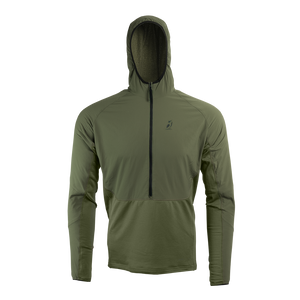
[00:35:22] Brigham: So that's the two layer part. That's the part of the jacket. That's gonna retain the most heat because it's both blocking one on the outside, but also has the most Loft on the inside. Yeah on those and those areas actually have the highest warmth to weight ratio on the piece so any of those two layer pieces actually they're the warmest and they have the highest, you know, warmth to weight ratio. And so we have that on the I'd say upper two-thirds of the front torso The shoulders and the outside of the arm from the shoulder, all the way down to the to the wrist cuff on the outer arm. That's all that, that kind of
[00:35:59] Brigham: hybrid, two layer combination and then in the back, It kind of goes from the top of the shoulder straight down, kind of between the shoulder blades and then towards probably like the top of your lumbar, the it flares out and goes are kind of a round the side of the lower torso. That's the hybrid double layer sections again, maximize warmth and minimize weight. So those are our keys. So think of it in some ways almost like when like the concept of wearing puffy vest, the idea there is that, if you're keeping your core temperature, warm your extremity stay warm as well. And so the layering of that is over vital or it's over the heart,
[00:36:48] Brigham: it's over the arteries, going down your spine and back. It's basically over your main torso but then also the outside of the arm You know, it's not as much a core like how to say it? The nice thing about putting it down, the outside of the arm, is that it sheds, the wind. So that's where the wind. That's where the wind hits. The army take a lot of wind on your arms but because it's only half of the arm, still retain a lot of breathability and that's where we'll get into the second fat or the I guess the third fabric. Yeah, so the third fabric is, is a grid fleece and the grid fleece,
[00:37:25] Brigham: it kind of accomplishes two things, it's really low bulk. So we also use it in areas where for comfort and and range of motion and Mobility, it really benefits to have minimal bulk and so that is from the inner part of the arm at the at the cuff, all the way in the inner arm under the armpit, and then down the side all the way down to the side of the Torso and then under the lower, third So beneath or the lower third below the, the two layer hybrid, portion in the front, that's all grid fleece. And then in the back, The outer scapula area. So to the left and right of the hybrid portion
[00:38:11] Brigham: in the middle, basically, where ya, at least the outer half of your scapula. That's also grid fleece. And so, the other thing that the grid fleece does is adds a little bit of breathability. minimizes bulk and then it adds really good stretch, especially, so you could look at the back of this piece and kind of like Wonder, hmm, why why, why is there grid fleece on the outer scapula Well, through testing, all these different combinations of fabrics. it took a while before we like there was always just this slight sense of like we just wish that the range of motion kind of when we move our arms forward or reach or stretch, we wish there
[00:38:59] Brigham: was a little bit more give in the back and so basically that's because the two-layer portion Those Fabrics don't stretch at the same rate that the grid fleece stretches, the grid fleece stretches, a lot more. And so, in throughout, trial and error and testing, we learned that if we just put grid fleece on the outer scapula, that that really that provides the stretch and the range of motion and takes the stress off the two layer sections. So that that was like, Final key or the final part of the equation for that, that range of motion is just adding the stretch of the grid fleece in the scapula areas. And then, yeah, like I said,
[00:39:42] Brigham: inner arm kind of the belly area and that belly area. You know, again for for minimizing bulk, we wear backpacks, a lot. So we want the least amount of bulk where we're going to be wrapping the hip belt around the front of our body and buckling things down. And then It is it adds a little bit of increased breathability everywhere that grid fleece is as well? So
Editor’s note: The 75 GSM PrimaLoft Evolve, 30D nylon, 50 CFM air-permeability, warmth-to-weight, wind shedding, grid-fleece placement, stretch, breathability, and pack-belt comments describe the August 2025 design. Confirm current product-page materials and specifications.
[00:40:06] Tayson: yeah. so, man, when I, when I thought about this piece and how Describe it. It's it really is just a piece that it's like a windbreaker and a fleece hoodie like Blended together. In this kind of perfect combination. That gives you that, that all day comfort of like a knit piece of fleece or You know, think like a cotton t-shirt, you know, type of thing. But then you've just got those those panels that really block the wind and retain the Heat and and with that like like you mentioned about like the bat like adding those the grid fleece up the back that really was like the last piece to make this feel just like you
[00:40:53] Tayson: put on saying a sun hoodie, you know, or something. There's a lot of stretch in it. Like it feels that comfortable. And, you know, we ran this with more than 20 testers and the testers, I think all also kind of alluded to the fact that it like That it's just it is it's all day Comfort. Some of them said that they would wear it as a base layer like because it's just comfortable next to skin. It's flexible, it's mobile. You know, and I don't think you would ever say that about just a windbreaker, right, right. Or, I don't think you'd ever say that, like, with other other pieces of one of these Fabrics alone, but the
[00:41:32] Tayson: combination is just It's really, really impressive. Okay, so we've kind of walked through that. The one of the other big pieces on this just in terms of feature set, we did put a massive zipper on this thing. Yeah
[00:41:45] Brigham: there. Yeah, that was one of the two things that kind of didn't mention is yeah, again the whole thing would to kind of balance and optimize breathability heat retention and then we did not want to mess around with like minimal zipper again because I just want people to be able to put this on and leave it on and a big contributor to that is that it's a very deep Center Front zipper, it's more than half of the Torso. It's probably two-thirds length from the hood to where it stops, and you can dump a lot of heat really quickly if you need to. So,
[00:42:23] Tayson: it goes right down the center, right.
[00:42:25] Brigham: Yeah. And so like, Again if you're if you're really getting hot like it's covering your lungs in your heart so you can unzip that and expose all that and you can really dump some heat really quickly and and it's very effective.
[00:42:40] Tayson: Why not take that zipper all the way down? That's gonna be a question
[00:42:44] Brigham: for the bulk. Just for the bulk and the weight, again, hip belts buckles and all that.
[00:42:49] Tayson: There's a bulk, the way that I would say that might be like, putting a zipper underneath. The hip belt is not that comfortable, right? It's not, it's not, you can do it, yes, but it's not that comfortable, especially when it's something that's that close to your skin. You know, if you've got a few layers and then a jacket with a zipper and then your buckling, on, or if you're layering up like that. And you've got three or four zippers that are hip belt, it just becomes less, and less comfortable. Yeah, um, so yeah. Bye by doing this. This more than half is in the front. We accomplished the ability to expel the Heat. We accomplished
[00:43:23] Tayson: keeping the bulk down over hip belts. I think that one of the other side benefits of that is you can put like a locking zipper on things but in general like I can drop as it all the way down and it's not moving because if you what I find is that if I've got a full zip and I zip it all the way down to vent. Well, now that that jacket starts migrating around my body as I'm hiking and then I'm getting like a buildup of fabric behind my body here. Whereas, you know, this is It's kind of mindless where you can zip that down, and it's going to still stay on. So actually
[00:43:56] Tayson: see me probably in certain videos. For I will like zipper zipper almost down to the rain jacket. I'm trying to vent a rain jacket is a bit, almost the bottom. And I leave like, last, like three inches of it. It's kind of a weird thing to do, and it kind of works, but the zipper can still move up or down a little bit over time. Because you still want the piece to be wrapped around your body. And not be bold. You know, piling up under the lumbar, under your back on, on the jacket, which can happen. So, yeah, that's that's kind of the reason for the, the half zip approach to this dump heat, keep form
[00:44:29] Tayson: on the body. Keep bulk down where you're potentially stacking zippers and have a hip belt coming around. Yeah. We I mean as far as other features there are thumb loops to that. I would call I guess you'd
[00:44:45] Brigham: call their Loops thumb Loops. Yeah,
[00:44:47] Tayson: thumb Loops, they're not cut into the fabric so you can put them on layer up, layer down, pop them back off. Yeah, but they're not necessarily cutting into the warmth of the fabric, which is something. We've also been testing with lately. If anytime you do that you're creating a cold spot down the sleeve. So good.
[00:45:04] Brigham: So I just gonna mention that the hood for, I forgot to mention the hood, is the double is double layer. So the hood uses the PrimaLoft, the PrimaLoft Evolve with the nylon face Fabric and it's it's a it's a close-fitting hood without being form-fitting. Don't see the, we didn't see the need to make it form-fitting, but it is. We absolutely wanted it to the collar. Come up just below the chin. And then the hood, you know, to stay put and move with the head without feeling tight. So it doesn't feel tight on your head. It just feels like it's anatomically shaped and so it just stays put and moves and moves
[00:45:43] Brigham: with you when when you're looking side to side up and down, but again, it's it's our head. So we want it to retain heat. So that's why we went with the warmest combination on the piece. Yeah, let's talk about some of the other fit aspects of it in terms of just how fits on the body.
Editor’s note: The deep center zipper, heat dumping, thumb loops, hood fit, warmth, and anatomical-shape comments are August 2025 design claims. They do not guarantee ventilation, comfort, or fit for every user.
[00:46:00] Brigham: Yeah, I mean really for all the materials, the Fabrics to to work optimally, and to to function as intended, this piece needs to be on the athletic-fit side. So that is one for the heat retention and then two for the the temperature regulation and the moisture management. So, for to get optimal moisture management, whether that's drying out or allowing the breathability of of water, vapor the closer, it is the better but this also is a layering piece. So we have to keep in mind that we're likely going to be putting this over, even a t-shirt if not a long sleeve, you know, Sun hoody, basically, or type hoodie with long sleeves. And so it
[00:46:46] Brigham: has to allow for that without being loose-fitting, we do not want it to be relaxed or loose fitting because that just takes away from the efficiency of moisture management and temperature regulation.
[00:46:59] Tayson: Yeah. Like a lot of other pieces drops a little bit in the back gives a little bit more coverage in the rear. Yeah, it's a It's, it's not tight fitting but it's not. It's definitely not baggy by any means. Yeah, what else are we missing in terms of just what the actual design. I mean, weight-wise size medium, you're 9.4 ounces. So Extremely light. I'm not going to say that. This is the lightest piece like, like technically a Ventus is around the same weight as this thing, but the dynamic nature of this is still really high and that's something that
[00:47:38] Brigham: very different application.
[00:47:40] Tayson: Yeah. Like I would, I would say this. I've seen a lot of, you know, from other brands and stuff when they're trying to build pieces like these man, they they make like All too often or heavier or they take like a grid fleece and they put it, you know, on a soft shell or something. You've got like a one and a half pound jacket or two pounds. There's just seems like people really creeped the weight up in some of us. And so, I am really happy with that weight. around 10 ounces under 10 oz with a piece like this. It's, I think it's really impressive to be able to use grid fleece because grid fleece
[00:48:15] Tayson: can be a little bit heavier at times. It's about to be able to use that application and everything else. It's a, it's an awesome weight again. Can you find a, you know, a puffy jacket? That is warmer for that weight? Yes. But that is not the design intent to this it, you know, the design intent to this is active insulation. It's different. You cannot be active in a down puffy jacket. You can, you know, do the same things in the jacket as well, you plan to do in this.
[00:48:44] Brigham: Exactly. I mean, even even the mobility of the range of motion thing, you can't get that with the combination of materials that you would need to make a down puffy jacket. So if for, for like People to do. Ski touring or even climbing mountaineering alpinism you know, you're grabbing an ice axe and you're reaching. So you've got a bent elbow and then you're aggressively swinging into a into ice face or a rock face and so You're active your physically climbing vertically, creating body heat, but you also need to be able to reach and extend, and bend the arms and so, yeah, that's a good point.
[00:49:26] Tayson: yeah, let's just talk about like some of the application side just like you kind of started on their you know when are you taking this piece and who needs this piece, you know,
Editor’s note: The athletic fit, moisture management, layering, 9.4-ounce size-medium example, and comparisons with fleece, softshell, Ventus, and down pieces describe the August 2025 product and design intent. Verify current weight, fit, and specifications; active-layer choices remain condition dependent.
[00:49:37] Brigham: you know, me personally and and I'll just be very straightforward if it's If it's summertime and I'm going to the mountains. If I know it's going to be, I will take this piece as the only insulation or warmth layer that I'm going to take. If I know it's just gonna be really warm like the overnight lows are not going to be that cool. Then then I would take this piece just as whatever, I'm gonna layer up with it, and I just for that, take take the slight edge off. But for me that's not its best application for me. It's kind of like all the other shoulder Seasons or weather conditions where I'm going to be in
[00:50:19] Brigham: colder temperatures and I know I am going to be moving a lot or intermittently a lot and and I need Mobility. I'm going to be sweating in it and I just don't want to take it off. So for me that is more applicable, you know. If it's in the Rocky Mountains, more applicable, mid to late September, you know, through April. And I've kind of done a lot of, like, kind of analysis of where, for me, the optimum range of like, if it's cold and I'm hiking in snow, that's that generates a lot more work, you know, it's for me, it's kind of like this 15- to 35-degree range of if I'm steadily moving,
[00:51:06] Brigham: that's You know, that's where it is. And so that's kind of what I'm taking it. Yeah, I
[00:51:14] Tayson: personally I don't think I take this in the summer. I think I bring more of a puffy jacket and maybe a windbreaker for those conditions. But as I looked back at even some my own photos, like I took it on my Wind River High Route last year which is like the first week of September and I did use it. The overnight lows are getting down to freezing sometimes just below and if I had one cold snap come through there, I probably would have put a lot of miles in that thing. You know, because it has that potential. So I was wearing it basically from September. I took it to Colorado for a week and I
[00:51:51] Tayson: like didn't take it off my body that week we had we had blizzards come through for two straight days and then it was, you know, chilly and and so I mid-september. I used that thing every single day for I'd say 80% of the day mid-september, and then after that, October, same thing I use it. A ton all the way into the spring, this spring. I did a lot of low country desert hiking, but typical spring, I would be using it, you know, as we're getting into the mountains and kind of chasing the snow lines up, the mountains and stuff like that. So yeah, temperature range for me. It can vary can vary on the amount
[00:52:32] Tayson: of wind it can vary on the amount of, you know, the actual temperature itself. But yeah, I agree. I mean, I'm probably hiking in this piece when I'm, you know, 40 degrees and below. You know, kind of in that range if it's higher than 40. I'm probably just doing windbreaker or something, more on those categories, but there's the variability of the wind in there. If there's a lot of wind, no windd things can change, but I do think there's a lot of movement there. And then and then two like just like Brigham said, just because we talked about this piece is like can was really designed to be worn like for big chunks of time.
[00:53:08] Tayson: You can throw it on like a lightweight jacket at any point, and use it like a lightweight jacket. And it's going to be a good, a good option for that too. So I think there's a ton of usable. Aspects for this piece. For a lot of people but there's hopefully, those are some parameters, you can kind of take to use. Again, just kind of coming back to this. This piece is really unique, there are a few different pieces out there that, you know, try different things. But man, we really dialed in the body mapping specifically on the piece and Stretch in the comfort. And I think you guys are gonna just absolutely enjoy the heck
[00:53:54] Tayson: out of it. Once you take that and put it in the field, we also worked really hard to get the pricing to a great spot. We're using three different Fabrics, you know, there's obviously manual labor, that goes into this, there's the sourcing of those Fabrics. There's, there's some things there that can add up on price points and there's, and there's name brands. I mean, we're using Japanese fabric for the outer we're using primaloft which, you know, they're they're top tier manufacturing. I mean the grid fleece comes from a super reputable. So it's like so we're not we're using some of the highest and most expensive Fabrics to build this piece and bring it all together.
[00:54:32] Tayson: But super happy with where this price point landed. Yeah
[00:54:36] Brigham: right on that. I would just say the price point ended up where it ended up, and I had zero influence on the design or selection of a single material on this piece. And hopefully, that kind of sinks into the listener and they absorb that if they find any other piece is out there because there is no sacrifice or compromise in terms of
[00:55:02] Tayson: materials.
[00:55:03] Brigham: That on this piece like there is not a single choice that was affected by price. We use in fact, the combination of materials we use is Quite expensive. So yeah. But we're so business that we're in and we do it the way that we like to do it.
[00:55:20] Tayson: Yeah. So I say like we we wanted this price to be what it is what I mean by that is we're literally taking lower margin on this piece to get the price point to where it is like our own margin, our own markup. And we, you know, obviously the more we order we can get tiny, tiny price breaks. And so we did try to do that as well. But really happy with this because I think we price it, very lean, and yeah, I just think it's it's going to be an exceptional piece for a lot of people, especially when you go out there, start comparing it to other. Anything else? Really? But yeah, I mean,
[00:55:57] Tayson: overall, I think this is just one of the most unique pieces in the Mountain Pursuit line. It's a piece that I think will fast become one of the favorites of. So when we did this testing with this group of larger testing group, right of 20 plus people, this was the piece that came back like, I mean, you talked to him. So like you constantly said, like this is the piece that they were just the most excited about, or the most positive feedback about.
[00:56:22] Brigham: Yeah, 100%. Yeah, Far and away. It was. I mean, He got. A lot of positive feedback. I mean, people didn't hold back like they would mention anything that could be improved, but it just as time went on, I mean, people are really everybody that tested this just had so many good things to say about it. And and the excitement about it is very high.
[00:56:49] Tayson: Yeah,
[00:56:50] Brigham: for sure.
Editor’s note: The fabric sourcing, material quality, price, margin, order quantity, tester count, and feedback comments are an August 2025 business and testing snapshot. They are not independently verified current price, value, durability, inventory, or performance guarantees.
[00:56:50] Tayson: And while we ordered almost double what we would normally order on a first purchase order, this is the piece that most worried about us stocking out of the fastest based off of conversations and feedback and stuff like that. So, So again just to reiterate this product is now for sale on presale. We did that to try to get it in your guys's hands as fast as possible. This fall season. So what it is on presale, only for about three weeks before we're able to start shipping it around the first of September. So we want to give you guys the option to one get the earliest ship times possible. Because we did break this into two