Tayson: Hey, what's up everybody? Welcome back to the Live Ultralight podcast. Today, we have a product podcast, so you go over one of the favorites, one of the deep Dives, one of the stories behind why we made a product and just all of the details that go into making a product. And today it's going to be, I'm know it's going to be very popular one because Our jackets have done very, very good historically. And this is going
Tayson: to be no exception. In fact, this jacket is just impressive at every angle and at every level. So I'm very excited to go through the design of the new Nova jacket line that includes the Nova ul and the NovaPro as per the usual. We've got Brigham here on the podcast to walk us through this as well. So welcome Brigham. Thank you.
Tayson: You ready locked and loaded to dive into this always Okay.
Tayson: I figured we'd start off by just touching some of the quick highlights. So you guys know what's to come and then we'll go into kind of the backstory. So with the Nova line we are launching two jackets, those two jackets are basically going to replace the LoftTek Adventure jacket, so the million dollar jacket as a lot of you guys know that piece. I'm going to be more or less replacing that and then also the regulator
Tayson: down jackets. So there's gonna be two different weight categories. Two different Temperature categories. But that's, that's essentially with the Nobel line of jackets is going to do and as pioneered by two different Innovations one, we've been calling the Nova zero Stitch Fabric and the other one is the down, LT insulation. So, they're gonna be big things to watch for both of those. Have a lot of innovation that went into them, have a lot of performance benefits.
Tayson: And so, stick around to hear what those are and how they work and what they're going to do for you when you're wearing this piece. So, with that, I guess I wanted to back up to some of the backstory specifically with the Loft, Tech Adventure jacket and all the success that we have had with that piece. So, 2018, we actually released that on a crowdfunding platform called Kickstarter. We're raised about 750,000 dollars and where I made
Tayson: a bet and lost and had to shave off my beard. So, that's another fun one to go look up in the archives, but we then took it and put on a different pre or crowdfunding platform where we're doing pre-sales while it was being produced. And so, before we ever started shipping this product, we actually sold over a million dollars worth of this jacket. And the primary reason, the primary selling point you could save. And with this
Tayson: jacket was the insulation, loftech LoftTek is a synthetic to loose fill synthetic. So most most synthetics come out in sheets that are kind of bonded together. Whereas, this is a loose, so it looks and acts kind of like down where If flows you can blow it and it would just cover the room, it's not connected in any way except for the individual fibers are connected kind of in small plumes. I guess you could say kind
Tayson: of like down as anyways that piece looked like a down jacket. It acted a lot like a down jacket, but the insulation would collapse when it got wet. Because historically the big downside to down is that if it gets saturated and wet, it can collapse. And then really, the biggest problem from there is trying to get it to dry out if it completely collapses down as extremely difficult to dry out in the field. So, That piece
Tayson: did extraordinarily well, and a lot of that Innovation where I guess a lot of the pushing for me to develop that came from. So my own use of down in the field and not having any faith in it being really concerned about it. It collapsing and not puffing back up and there's particularly one time that I was out in Colorado for about seven days. It was snowing the whole time. I was hiking around and I was
Tayson: so nervous about that down, you know, getting moist and collapsing. And losing its value that. I ended up really not wearing the jacket hardly at all, unless it was like in my tent and then I came back from that because it was freezing cold, like, the whole time. I actually got frostbite on my feet, but really just really cold out. And I just never used the jacket because these fears, I had Which we won't get into
Tayson: the nuances of that. But could have been the down that I had the lack of faith in it, etc, etc. But at its core, there are concerns and fears with, with down insulation, and there's things to to work on with that. And that's really where the success of the Loft tech jacket came into play. Well since releasing The Loft tech jacket, we have been we haven't just stopped working around here. I don't think Bergen thinks that
Tayson: for a second he's always got a million things on his board and so we've continued to develop and innovate for improvements and that's exactly what this Nova jacket is going to be. It's going to give those of you that love the Loft jackets. You are not going to be Disappointed in this jacket, it's going to give you those moisture benefits of, you know, lack of failure and moist environments, quick drying if it ever did get moist
Tayson: Etc. But it's going to give you a whole lot more than that. So that's the backstory of where this piece is coming. And we've been working on this piece for a handful of years and it's a lot of fun to finally be able to start sharing the details. So With that introduction. What did I did? I miss anything they're bringing them. Or are we ready to dive straight into? The first R&D sides of this piece I guess.
Brigham: I don't know. I think that sets the stage pretty well. Okay.
Tayson: so to be honest, when we, when we started development of this jacket, it was how to say, I say we didn't we knew that we didn't want to just move away from LoftTek by any means because it was it really solves such a good problem and a lot of people were responding to that message, they clearly understood it wanted it and then there's there's feature sets to that will get into the people like about those
Tayson: jackets, things like pit Zips and stuff. So that was like a, I would say like a design parameters. We started to look at some of these as we couldn't just Delete, the Loft tech jacket. Right, we had to solve the same concern as we developed a new jacket and make sure that people still had that faith in in that. But we wanted some of the things we wanted to improve upon. I would say we set out
Tayson: on this was, we wanted it to be. A higher fill power piece of possible, right? Because that was that's one of the tough Parts about working with something like a synthetic is down is just a truly unique substance and it just has not yet been duplicated by man in any way, shape, or form. As far as the amount of warmth for weight the And just the overall durability. Compressibility, all these things that down really offers in
Tayson: that in that type of category has not yet been duplicated. So when we're working with LoftTek it's kind of limiting as far as how far we could push that fill power. So if we wanted to make a jacket that was lighter warmer but still offer those benefits. That was really the question in hand as we started to get into this. So I guess what side of the development do you want to tackle first, you want
Tayson: to go straight to the down LT side?
Brigham: Well, I would maybe I'd frame it a little bit. to just say, That we wanted to make a better jacket. I'd say that was a goal meaning if it wasn't going to be better than the Loft tech jacket and there's no point, right?
Brigham: And there's, you know, so we didn't want it to just be like better in one category, it had to be substantially better. So we wanted it to be warmer lighter more compressible. And there's, you know, Various ways of accomplishing that. So that's yeah kind of what kind of Set It Off and turns of kind of give us the goals and the objectives to work on and Then. Yeah as far as where to begin I mean yeah
Brigham: we could go come out from a different few angles.
Tayson: So let's just dive straight at the insulation. That's probably that's realistic. I think where we started very first was. Was with the concept of was the fabric. I don't know. I thought that
Brigham: it was good. Yeah, honestly.
Tayson: I think, I think, at least, in my mind, the Was crunching before we started to move into some of these other things. But so let's let's start with that. So As we used the LoftTek piece, it was incredible. But what happened over time two is, we started to use hyper dry down and hyperdry is a wax based DVR coding for down. And the results from it really impressed me. So that's what we're running in like
Tayson: our sleeping bags. And so we have the regulator and maybe some of you install. I can add I did with the regulator, whereas out in the rain, and just kind of showing how well it did. But really that, that really, really impressed me how well, that down with that treatment could do in the rain. And so from there, it became kind of like, okay, really, really impressive. But again, we still need to make sure it can't
Tayson: fail and that's where we started to think about blends. And, and potentially blending, our previous Loft taken installation with a down and seeing what might happen there. So we started doing a handful of tests on blending different proportions of down different Phil powers of down different percentages of LoftTek and those either followed as a while you know that we had a previous hybrid insulation that was pretty much loftech with a little bit of down. That's
Tayson: no longer the case of noun, LT. Dan LT is majority down. Almost all down type of insulation, with just a little bit of this LoftTek. As we went through that process, we went from testing, you know, our hybrid stuff was like an 80/20 LoftTek 80% 20% down. And then we went into the R&D thinking, all right? 50/50, and, you know, these different percentages working down because the goal would be how little LoftTek can
Tayson: we use? So we're using almost as much down as we possibly can but still get the benefits of what LoftTek can do, which would be to keep it from failing. And essentially as we started to test it, we were really impressed with the results. We found of LoftTek would hold up that down. Even when you were holding on a water compressing, it underwater soaking the water into the fabric and into the installation doing that
Tayson: over and over again, that little bit of LoftTek would keep enough Loft. That the water would be able to drain out of the baffles out of the insulation and then that hyper dried down as is impressive and it's own nature. And so It just stayed lofted. I mean, I I mean and so we went through all these different variations. And essentially found a percentage blend where we were able to produce an insulation that was would
Tayson: test out at an 800 fill power or over an 800, fill power level. But had synthetic blended into it to offer that. You know. Full moisture, I guess you could say from failure, especially. in fact, I think one of the things one of the days that was the most telling is when we did that type of a test, we took You know, hyper like a pure hyper dry down. Took other down and we took our the
Tayson: blend that we were we were worked up to to that point. And we did that test where we just completely compressed them, you know, compress them underneath water. Let the water soak into the fabric soaking into the installation and did that for. I feel like I was doing it at about five minutes at a time, trying to get it as wet as possible. Then we'd pull him out and measure the Loft difference is and this isn't
Tayson: super scientific. We'd have to look back at notes. But roughly what we saw was that Down could completely fell. Hyper dry down was staying at like 50% Loft and this blend was somewhere between like 70 and 80% of its normal Loft. And then from there, we took them outside and put them in the Sun for a few minutes and this down LT blend, just Like it, just dried out so fast on this back to Total functioning
Tayson: levels way fast. The hyperdrive did pretty damn quickly, but then the down, you know, where it's completely compressed. Like was not even in the ballpark, like it didn't even dry out like you almost have to. Mechanical system to such as a dryer. Right to get that piece to dry out because it's just a full collapse, you know, when it collapses fully or even a class down to like 10% Just no airflow. The water is clinging on
Tayson: to everything in there so it's not draining out and and made a massive difference. So, essentially in our testing, what we found is that Down, I'll tee. It wasn't failing when we saturated with water and retained a ton of its Loft and then try it out incredibly fast. And don't get me, wrong, LoftTek insulation, you know, if it was wet just because the heaviness of the moisture too, it's not going to be like it dry.
Tayson: If it's 100% Loft and then you get wet, it's not going to be 100% off. They're still going to be some level of Loft. Lost, you know, maybe it's 20%, maybe it's roughly the same as this down, I'll T, but more or less. What we saw is that it would be close to what the same level of this down LT is, but this blend kind of the magic of this blend. Is that it's able to just
Tayson: push that fill power level, so much higher, which then allows us to create a warmer lighter piece. um, what I miss I guess from from your perspective of developing that that insulation
Brigham: Yeah, just to kind of go a little bit. More specific on. Like what? How did we test this? How did we test? What did we do to test this? So we had Our down supplier mix up varying or just differing ratios of down and synthetic had them Blended up just like they would do for like mass production and we just got like three or four different ratios from them. And then, you know, we set we took
Brigham: that insulation and we sowed just like some simulated baffles into like the same type of fabric that we would put in a jacket. And then we kind of started from there with
Brigham: You know, soaking it and smashing it, and completely, you know what? It took together to collapse. And then kind of just recording our observations really and then that helped us hone in on the ratio of down to synthetic that we found that we got the most bang for our buck really where we like taste and said we're trying to get the most down with as little synthetic as possible with the capability of basically being Infallible or
Brigham: impervious to, you know, failure. So meaning that if you were to physically completely smash it, once you release the pressure, it
Brigham: would automatically start lofting itself up. So we found that that ideal ratio and that's where kind of down LT comes from and then yeah, just
Tayson: to know with that is That development. It might sound like simple almost like oh man you just you know you're doing these different issues but like it was a it was a drawn out process. And one of the main reasons why is I don't know if there's one or more than one but I'm but this can, this blending takes a very special piece of equipment that is only with our supplier in the USA and so Essentially,
Tayson: anytime we wanted to do this, we were kind of sourcing materials had to go through one particular piece of equipment, done by one guy who had to do it at that time or it was a pretty, you know, because it was a different ask, like not. There's something that's done regularly. It's not done ever with this particular synthetic. So this was a completely new thing for them and so they were working through their own systems of.
Tayson: Okay, how do we blend this? How does this work? And so that also added to some of the the production or the R&D time of this is you know, not only are we working through our, you know, ideas that they're working through their ideas of how to even
Brigham: get this together. I think that's, that is an interesting part about the development, is this, we're not just like, requesting like, you know, some SKU number of and off the shelf insulation. We're basically co-developing Insulation with an insulation supplier, doing something new to them and new to us and then just communicating back and forth and, you know, we knew exactly what we want and they have the ability to make it for us, even if they don't
Brigham: understand why, you know really because right as long as they have the capability to make what we want, we know what we want out of it. So yeah like I said it was kind of co-developed with our supplier and yeah once we nail down that ratio and then we you know we had it put in a jacket.
Tayson: Yeah so yeah so we worked through all this and by the way too for full production we still have the same limitations of having to Get this insulation Blended and one specific machine and so on so forth. So that's just kind of an interesting part that's still ongoing for us because it is such a unique insulation piece. But anyways, yes. So we get that, we get the, the Blends kind of dialed in and we started to
Tayson: work on the fabric side. On the fabric side, we had been using and we had some ideas of what we wanted to use, which was probably the same thing like our LoftTek pieces using, you know, 20 10 year nylon outside and attending on the inside. So, and so forth. And but With our fabric supplier that we were using, they had some other options going, and I don't know if they suggested, we suggest that you might
Tayson: remember this but they had developed a different technology for a different way to weave together fabric. In a but not in the class or category that we wanted it. So essentially, they had This. Stretchable. Fabric. That was a heavier Fabric and had a lot of spandex in it. But what they were doing is they were taking each individual fiber yarn piece and they would weave it together so that the baffles were created at the same time,
Tayson: the initial fabric was being woven together. That's really hard to explain how that works. So Brigham, how would you explain that? Just take it two perspectives on this.
Brigham: Yeah, so they think of them like weaving a fabric and most fabric that you think of comes off. It's a it's a single layer of fabric the way they weave this fabric is the fabric is essentially two layers of fabric. So as all the hundreds of thousands of Yarns are converged and woven together, On, you know, onto on a big sheet, it comes out, being two layers of fabric. Imagine just like the two layers of fabric
Brigham: on any puffy that exists out there except this is all one piece of fabric. So it's two layers of fabric as one sheet of fabric that goes on to one roll. and it's Woven I guess like at a different angle or something to wear at certain intervals. It weaves the two layers together so they are they Converge on each other. And they close off baffle. And they do this kind of in two different patterns, one that's
Brigham: just completely, straight across the whole heat of fabric. So as the two, Layers of Yarns convergent or woven together. Then they release again. So then you have basically two layer fabric that converges to basically one at a point and then opens up. So you've got two layer fabric with gaps of space in between at like different intervals so those baffles that are created are the same as what you would see on a pretty much any puffy
Brigham: jacket out there today that they accomplished that by taking two separate layers of fabric and then when they're making the jacket, they stitch them together to create baffles or spaces to fill with insulation. So it's it's something that we've never seen before. And yeah, the first time that we saw it was at the factory in Vietnam and it was this fabric that they had that was like a stretch woven fabric. That's the first time we'd seen
Brigham: anything like that. But then Fast forwarding to, you know where we are. Where we? Developed this insulation and then you know, when about this type of fabric, where it was the phenomenal thing is that you don't have stitched baffles, right? So it's just the nature of the fabric because it's got these gaps in
Tayson: these spaces. Yes. So many that are watching the video like because so if you go to YouTube you can watch this on little light podcast. Channel. But I'll kind of hold this up to the camera so you can see it looks just like say our Loft tech jacket baffles like the same height thickness and from a distance, you couldn't tell. There's no stitching, any of those baffles, but go on, right? So,
Tayson: Um, yeah. So now you have a fabric that is a
Brigham: two-layer fabric with baffles that are not sewn in, we
Tayson: requested you Brigham to do a little bit of counting to turn into an accountant here and count some beans for us, but what did you discover how many less holes, needle holes from not having to sew those baffles versus having them woven straight from the fabric. When it's being woven, how many less? How much? How many less holes? I'm saying that wrong are in that jacket. Yeah,
Brigham: well yeah, one day I decided I wanted to count how many Stitch hole are in, like, Just as easy as to use our own jacket at The Loft tech Jack and has like 12,000. Some odd Stitch holes in it in the size medium. And then I counted the number of Stitch holes in these in the Nova jacket. Whether it's a pro or a ul and there's like Plus or minus 100 stitches about 1500 Stitch. Hole. So
Brigham: you know around 11,000 less Stitch holes in these jackets versus, you know, a stitched, baffle poppy jacket, so that's important. Why does it matter?
Brigham: So, like, so think about what you're talking about. It's a jacket, right? It's a, it's a shirt. People generally avoid snagging their, their shirt, or their jacket, their clothing, they generally avoid wearing holes in their jackets. Well every puffy jacket that you buy from the store starts out with tens of thousands of holes, poked in it and granted they're they're intentionally poked through there and they've got threads sewn through it. But When you think about it,
Brigham: it starts to make sense. So, less holes in your jacket is probably better. Just like less holes in your pants is probably better and just like, it's a concern. When you have a hole in the knee of your pants, if you think about it on a smaller scale, like, Less holes is better. So this is exponentially less holes in a jacket. So what that does is it totally improves the wind resistance. So every hole in the
Brigham: jacket is a place for wind and water to get in and for body heat and insulation to get out. So it makes a very weather resistant jacket that ends up just the fabric alone, makes it a warmer jacket and it makes it incredibly more durable. So if there's 12,500 Stitch holes, well, there's stitches going through every one of those thread going in and out of all those holes. The most common thing that snags and we know
Brigham: this because we sell jackets with fish holes, right? We have a warranty department, like the most
Brigham: common thing is snagging those Stitch holes or those threads in between the stitches. It's very common. And it's So now that is basically completely eliminated. The only stitches on the jacket are where various pattern pieces or panels are sewn together. Like we're the arms are sewn to the body and so on and so forth. So you can't snag a stitch
Tayson: talk a little bit about like and you probably can't quantify this, but like if you were to just think about this, Every time you poke a hole in a fabric it's compromising that fabric at some level or a strength or something, right? Yeah.
Tayson: Make sure. I don't know, I don't know. Like, we don't have figures or numbers to explain that. But like if you just think about, like you've got a perfect like so say, it's a piece of paper, right? You were to like, pull on each end of that piece of paper. I can you feel the strength that paper? Now, if you're to go along that piece of paper and punch needle, size, holes, all the way across that
Tayson: paper, like it's compromising the quality, the strength of that paper per site. Now, it's different. It's different, but I'm just showing like for an example, think of it, kind of like that, where every time there's a needle hole that goes through that fabric, it's reducing the overall strength of the fabric. It's reducing just the, the Integrity of that fabric, with every little punch.
Brigham: Absolutely. Think of think of your house. The walls of your house have insulation in them now. if let's say every If you've got a 9 foot wall on the side of your house, in the living room and every 12 inches. You poke a one centimeter hole in that wall? Every. Three inches. So your entire wall has an array of holes poked through it. Yeah.
Brigham: The question is, is that wall? 100% as strong know. And If it's winter time, what's happening to the heat in your house and what's happening in the summertime or whatever and the wind? So another I think kind of or underestimated benefit of this is Preventing dirt and other impurities from getting into the insulation. So, think of how lightweight down plumes and clusters are there incredibly lightweight. They're not tolerant to holding up. Like that's a good foreign
Brigham: object like in the form of mold and dirt. So thousands of holes in your jacket now eliminated makes it way harder for dirt to get into the insulation and dirt and oil are basically like the number one degrader of fabric. It's not like the abrasion from you know the occasional brush up against the wall. It's literally like if in a field you piece like right for a backpacking thing, like dirt on fabric is the like it's
Brigham: a huge contributor to the breakdown of fabric and same thing. This is a
Tayson: good topic actually like to get into that. So let's kind of let's hold up and just dig a little bit deeper on that. What I think what you're getting at is once you get dirt in the fibers, right? All that's doing is it's just moving and grinding every little journey against all those individually yarn that make up the fabric. So
Tayson: I don't know, you know, probably if you're listening this podcast, probably not a big climber, but like climbers are Crazy about not getting dirt in their ropes, like they never want their ropes to hit the dirt. It seems like and and stuff like that because that's what's going to break a net. You get dirt in there, it starts grinding and essentially tearing up at a tiny tiny miniscule. Level those Yarns that make up that rope and
Tayson: same thing you're saying with the fabric. Yeah,
Tayson: so okay. So I really like that. I just wanted to make sure people kind of got what you're seeing there because that that is a really interesting point, but also keeping that down keeping the dough clean clean is a massive factor and you're talking about high fill power Downs, doesn't take a lot of pressure on that down to
Brigham: Speed The Loft. Yeah, so so whether it's You know, fibers of a fabric or fibers of down, insulation. The accumulation of dirt and bass call it impurities, or just call it dirt. It. Financially increases so like the dirtier gets the faster, it gets more dirty. So so a nice clean piece of down. You want to prevent dirt from touching that down as much as possible so as soon as down starts getting or as soon as dirt
Brigham: starts getting in contact with the down, the more likely more dirt is going to is going to adhere to that down because what it really adheres to is other dirt. So Just extends the lifetime, the usable lifetime of the down. It just makes the down more effective. More effective for a longer period of time. You want to just keep it clean. That's why we Advocate washing your down products. So this Fabric and insulation system really when
Brigham: it comes together, it creates a jacket that is Much more weather resistant whether that's wind or water. It's warmer. It's more durable. It's it's cleaner. Keeps the insulation cleaner which is all just basically exactly what we want to do which was make a better jacket at one that wasn't just a little bit better but substantially better. So
Tayson: and before we get too far off this, I want to share a little bit about this about the water aspect, but I think the big thing about the Nova you know zero switch fabric is, is the fact that you almost have to wear this in the field to fill the difference. So With wind for instance when the wind is blowing you can tell you can tell in the field absolutely. The difference in their LoftTek piece
Tayson: versus this piece and the Stitch holes that that wind is blowing through. So that's that's I just want to and a lot of these things like you will, you will find their benefit in the field like you're trying to conceptualize and help you understand it. But like when you wear it you'll get it. Yeah.
Tayson: And then the other thing is with the water. This is not a rain jacket, so don't confuse me with the sense that I'm saying, this is a range jacket, it's not purely for R&D purposes. I took this out during a rainstorm here in southern Utah. And for about 45 minutes, we were outside in active rain and it wasn't just a drizzle like it was raining. For 45 minutes we're walking around moving stuff around the yard plane
Tayson: and plane essentially outside. And at the end, we came inside, I took the jacket off and I looked at the inside and it wasn't wet anywhere, which was crazy to me that it hadn't got through. And here's the reason why because it doesn't have the stitching in the Stitch holes typically what happens is when that water seems to hit the fabric it then we'll kind of Glide across. They do have your finished till it hits the
Tayson: stitches. Stitches then kind of holds some of those droplets in place, and then they have that opportunity to go straight through those needle holes into the inside of the jacket. So on and so forth, right? Because two, you're puncturing that needle hole on the inside Fabric and the outside Fabric and so it opens up opportunity at that scene to get into the down, just like you're mentioning as well. So it has incredible resistance to water, and
Tayson: a little bit of rain, or a little bit of this, a little bit of that, which is really impressive. So, not only is the down, not going to fail under that, but also the fabric works together with that down to make it incredibly moisture resistant, and that just impressed the heck out of it because I've had down jackets out there, had LoftTek jackets out there, I've had whatever and you get wet on the inside, even
Tayson: that ad Again, you probably haven't seen this ad but there's an ad out there for a regulator jacket where I was walking around a neighborhood for like 30 or 40 minutes. And then at the end, I filmed in that and even though the loft of the down was lofty and it still looked really lofty in that scenario. I was wet underneath, I was very wet underneath because it was coming through those seams and and that's a
Tayson: huge benefit of this fabric it. And again, it's like one of those things like it's hard to explain all the benefits. You get out of this fabric until you
Brigham: just use the fabric. Yeah. And
Brigham: so yeah I mean really I think Seeing it, holding it in your hands and then using it, it really kind of just explains itself. But then all, just when you when you just think about it and think about other things that you
Brigham: commonly use in life, like If you have a water balloon water balloon. You don't like poking holes in your water balloon like holes in products are generally not good unless they're meant to not hold anything. Well a jacket is supposed to hold insulation and body heat. So you know it totally makes sense that in like a regulator jacket. It's got thousands of holes poked through it. So like it only makes sense that water can literally just
Brigham: go through a hole. so,
Tayson: Tons of value in this. I guess so. To recap wind water. It's more durable. Keeps the installation cleaner. Those are like the highlights, I would say and then this does.
Brigham: Yeah. I know, I would agree that really, those are really the kind of the strong hit points, and then, but going back to the water. I mean, just to give people an idea of what, you know, it takes you said, like, you went out in the rain for like an hour which in and of itself. Like that's a very realistic thing. We do unrealistic things in a quote, Very unscientific lab setting like a bathroom tub or
Brigham: something. So, but to give you an idea of how like we were just trying to like fight like what's the failing point of this jacket like and it's
Brigham: basically near impossible to Manipulate. And like, Force. Like fabricate a failing point
Tayson: with the jacket. So in regular settings is like, well, yeah, even in, yeah, even in
Brigham: a simulated Force setting. When we basically, Tried filling up a tub with water and stuffing the jacket under their first of all, if that's all you try to do the jackets going to pop out of the water because it's just gonna float, because no water is getting into
Tayson: it, but it's very hard to get water in those.
Brigham: It's almost it's, it takes forever. Like, you know, that one day you were squeezing it as hard as you could before you submerge it and water and then it still wouldn't suck in water. Once you let go of it. So you have body weight on the jacket, smashing it, I mean pushing it very forcefully, because Even in those conditions, like the jacket. The materials and the insulation are working against you like they're literally physically pushing outward
Brigham: while you're trying to smash the jacket into the water. So
Brigham: and In the end. What happened is, you still didn't get it to complete failure because you physically just didn't have the body weight to to force it. But when you did pull it out, stuck it out and within like five seconds, Eyeball could pick up the jacket puffing back up, like it was like it was pretty mind-blowing.
Tayson: That that was the day. I feel like you really got sold on what was going on too. But like yeah, I mean for context too. When I would take a different piece without the Nova Fabric and do the same thing, it would sometimes like I'd still have to compress it, put it under the water and then you, essentially try to let it uncompress underneath the water and it would suck the water into the insulation and whatnot.
Tayson: And that could happen very quickly because like, I would essentially fill the tension, stop pushing out on my hands and at that point you just kind of pull the jacket out or let it sit in there. But there wasn't really pressure required whereas with the Nova It's like trying to suck that, that moisture in. And it just you're working against that fabric which is definitely super super hard and and then like you say when you get
Tayson: it out there we kind of compress it shuttering any water out and then just boom pop right back out. So it is it like that they all work together and one thing I wanted to come back to though as we started talking about the Nova fabric, we started to talk about this concept of how to build the fabric. We didn't talk about the fact that this is a custom fabric for us because so what we would
Tayson: you did say is we found out that there's this fabric technology. Other people are using it in a different piece, but then we went to our Fabrics. Fire and said, Hey look, it's really cool piece. They sent us actually a jacket with that sample and whatnot. And we're like, but it doesn't work for us.
Brigham: Yeah, I mean, the only we had to make our first prototype in the only Fabric in the world that was available and it was just a one kind that
Tayson: they had and still to this Dad believe. That's the only Similar fabric to. This is the one. Yeah.
Tayson: Like, it's like a 30 denier spandex filled piece. Yeah.
Brigham: Um, yeah, yeah. So that's so we. We had a prototype made but we still like we got the Prototype and and it just wasn't the fabric. Wasn't what we want. We wanted the fabric the weaving technology but like we wanted a lighter fabric, a lighter weight jacket overall. So we asked them if they had anything different and they said no like this is the only, this is the only fabric we make. So, you know, in some
Brigham: discussions we kind of told them what we were wanting to do. And we basically, they said, well, we can, we can try making whatever you want so we told them what we want and Made the first roll of fabric ever in what we've
Tayson: written a while and they basically they basically what they have to do is they have to go adjust all their machines
Brigham: have to recalibrate all the weaving machines because you're it's a different composition of yarn now. So they had to really kind of toy with it and and do what a Fabric Mill does and go through all their R&D, just to develop the fabric the way that we wanted. And so then, yeah, we we iterated through some, some they would make some samples and send it to us and say, hey, is this what you're looking for? Then
Brigham: we would approve it. And then, yeah, it took some, they had to calibrate and then, yeah. So we got a fabric that is completely specified by us.
Brigham: And accomplishes what we want. And now it kind of completed the package for, for what we want it
Tayson: yeah, so let's talk for a little bit now about just like using the jacket in the field and some of the tests things we've got to do with the jacket. Those of you that followed Along on our YouTube channel, you would have seen the Hardline Challenge. And a lot of us were using versions of the jacket during that, during The Highline Trail in the skyline Trail and a few of these You said yeah.
Brigham: Well before we do that, we haven't really covered that. There's two different jackets, okay?
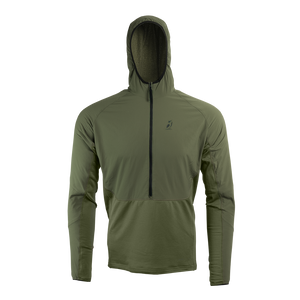
Brigham: That they all use. The same. Base fabric technology and the same insulation, so they're all down LT jackets so the Nova ul and the NovaPro. But they have a different appearance obviously, because the the baffle structure is different between the Nova ul and the
Tayson: NovaPro. So yeah we hadn't covered that yet. So yeah so I mean the best way to put it is the down or excuse me. The Nova UL is the Lighter, Jackie you out. Meaning, sending kind of for ultralight and those are watching that would be this piece and if you don't, if you're not watching, Imagine The LoftTek Adventure jacket. And like the baffle size and the look very, very similar to that less Stitch
Tayson: holes because we don't have to put in so many baffles because it's more stable insulation, but that is like the spacing of it. And as far as the weight of it, it's actually about a half an ounce lighter than our current Loft tech jacket and it's warmer. So a little bit more Loft. Same type of baffles and round a half, an ounce lighter. Very similar in weight though.
Brigham: Yeah, I mean, on my scale, it's an ounce and a half lighter. Oh, is it? Yeah, yeah,
Tayson: listen to this guy. I thought that's what you
Brigham: told me. No, yeah, it's it's, it's announced and a half lighter than the Loft, tech
Tayson: jacket. But like Tayson said, the noble UL. It's a it's what would be considered a sweater weight puffy
Brigham: jacket. It's got horizontal baffles. where whereas the the NovaPro is a much warmer, you know, jacket winter, weights, puffy jacket that's got about 50% more down, filling in it and So, yeah, that NovaPro is
Tayson: going to be, what would take the place of like our regulator piece. So, if you're aware of that piece, the baffles are bigger larger for more Loft and more insulation. 50% more installations put into it, talk about the iTube configuration a little bit, maybe why we did that. And what it I mean one, it looks sweet. Like everyone that sees that jacket is just like, that's so cool. Those of you that watch our YouTube channel like
Tayson: have been asking and commenting like what is that jacket? And it's not. So it looks really cool but like maybe talk for a second about what it is and why it's there.
Brigham: Yeah. So it's I mean, it's it's like, Their horizontally oriented baffles that are staggered and disconnected. So, let's just say each baffle. Section is like an inch and a half long. Then there's like an inch and a half Gap, and then there's another baffle section and then the row below it. They're staggered. So what it does is it creates a bigger area to fill with down. So it's more suitable for a warmer jacket because the spaces
Brigham: are much bigger so you can stuff more down as so that made a lot of sense for us to go with the warmer jacket. Using this type of baffle weave. and yeah, so what it does is it holds the down in place really well for this weight and warmth class of down. Yeah it just it just looks really cool but it's the same non Stitch baffle woven together, two-layer, fabric as they both use that same weaving technology.
Tayson: Yeah, it's it's really interesting basically, gives it kind of a grid. Patterned title look would be one way to kind of explain it. You know, where one, where the baffles on like say the UL or like four centimeters on the on the regulator are all down jacket, were like six centimeters now you're looking at like, eight, centimeter type baffles, but then offset, like they're 8 centimeters here, and then there's a baffle in the middle. And so,
Tayson: essentially, the net effects should be close to out of the regulator. But then you kind of get some side. Benefit of kind of where it weaves in here, which is hard to like. Put into words or measure the scientific benefit but I think from use that there's some there's some benefit as far as just less total lineage in the jacket. Yeah.
Tayson: Yeah that I would agree with that
Brigham: and one thing I will just not another thing. I'll point out is You know, one of the other one other Solutions are people doing out there to like take the holes out. Well one of them is that you'll have welded baffles so like that's
Tayson: that's a good we need to talk about. So for sure there
Brigham: will be puppy. Jackets out there or insulated jackets out there. That one are accomplished, the same thing of you know, they see. Why are you poking holes in your jacket, right? So they'll weld them together. While that does take the holes out. Big cons. There's a pretty mechanical Propensity or potential for eventually like that. Well, Losing
Tayson: its adherence, right? So there's not there's that I would say there's a few others too one. You can only weld certain Fabrics. So if I'm not mistaken, most of them, I don't quote me on this totally just when I looked into it and passed. Most of the welded Fabrics are heavier. They have to have some kind of like TPU on the inside or coding that's going to do the Welding which is then an additional coating and
Tayson: adds to additional weight in the piece. So that's a negative. Also the biggest thing for me too is Baffles are necessary but you don't want excessive baffles, right? And those welded baffles require like This is going to sound like not very much like the, but there are going to require like half a centimeter or more of a weld contact.
Brigham: So if you were like, that might not sound like a lot
Tayson: but it really adds up to be a lot of space in a jacket specially. So if every half of every weld is half of a centimeter thick compared that to ours, which might be like 10th of a centimeter at 20th of a centimeter you know, something tiny and minuscule. Like that there is absolutely a warmth value that changes hands to from that. And again especially as you add that up over the course of the whole jacket,
Tayson: you might be talking about like, five inches of Gap space or way more than that honestly. Yeah,
Tayson: not five inches. Sorry. I was thinking five centimeters, but let's say probably more like 10 centimeters of excessive baffle areas that are just welds, so insulation, not insulation. Yeah. So
Tayson: so you might see some of these, you might ask that and you'll, you'll figure that the other thing. I would say two with that is you'll see what the welded pieces. There's welded pieces that are a lot of money. There's a lot, there's but there's a lot of what I've been seeing lately is a lot of people that are using the welds are using it to cheap and costs like it's not really a performance factor. It's
Tayson: a we can build welded jackets cheaper, it seems like so I'm seeing a lot of them pop up and the I don't know if in Walmart or Costco or somebody's places that sell massive amounts of jackets at really good prices. I've been seeing some of these welded type jackets in up there, but there's also really high end ones as well. So you might see that that must be a factor along the line somewhere is that they
Tayson: can they can pump out a lot of those for a good price to, whereas, this is, I think a little bit more of an extensive process and but it ends up being way, more performance driven fabric too. That's a really good touch point and now I'm totally lost somewhere. We are with the
Tayson: fourth round two jackets. Yeah. So those are the differences in the jackets. Is there any other? Maybe maybe really quickly? Let's run through the features and then, let's talk about Trail time in these jackets. So, yeah, it's gonna have the same feature set as some of our other jackets, which is two-way adjustable Hood. So you can tighten it around your face. You can tighten it on the back of your head. So that, as you move your
Tayson: head around, it turns with you, it's going to have adjustment on the Hem. So, inside the pockets, you have chords that you can pull on to tighten the bottom of it, that's on a critical in the field. Just so, you know, like some of you Never use that. But when you are in the field tightening that jacket down around the bottom, half of you keeps a lot of warmth in.
Brigham: Yeah, you kind of don't you you know when you need it. Yeah, when you need it, you know. In a word feeling cold air blow up the bottom of your jacket.
Tayson: Yeah, so you've got the Hem adjustment on the arms of the jacket. You're going to have thumb hole Loops for layering primarily. So you can, you can use that to layer on. If you're pulling a rain jacket on, let's say over the top of this or something like that you have that ability a big one that maybe let's take just a second. On that pit Zips. Yeah,
Tayson: almost no one has pit tips. It's one of the highest rated talked about things on our jackets. What's going on with that? Bring why do people not fits and why do we have this? Yeah, it. Well,
Brigham: it's funny because in the last two days I spoke in individually to one person that was on both sides, meaning yesterday, there was a personalized. I don't really see the point in pit Zips. I don't I don't want them. I don't care that they're there, I don't use them. And then today, I was talking to somebody and she was like, I love the pit Zips. It was, it was somebody that has this jacket and you know,
Brigham: she just totally loves them and I just I even told her I said that's just it's just so interesting because there's they're really like people are just like I really don't want them and then people that really want them and
Brigham: like Tayson said, we've chosen to put them in both these jackets. So the Nova ul and the NovaPro both have the same Percent, including the pit zips. I don't know. I I think it's Like having the option to just release some heat. In this scenario that it's not always perfect timing to take your jacket off. You know, even if it's like a mental thing where you just want to get Done with the days mileage, right?
Brigham: It's just like can I just get this last two miles done? Even though I know I'm sweating? I don't want to stop and take my pack off because that means, I have to stop my feet swell up and then then I'm going to want to like use the bathroom and then I want to snack and then it's 20 minutes before I'm on the, on the trail again, just that kind of scenario where it's like, it's just
Brigham: we choose to have it so that if you want to extend the the Comfort level meaning if it's could be the difference between you getting uncomfortably hot and just okay, but I'm gonna deal with it, you know? Unzip and I'm gonna unzip my pit zip and the difference between sweating and not sweating and yeah, that's that's why we chose to put them on there. Yeah,
Tayson: I mean the cons are it could add a little bit of weight. It definitely adds some cost in production. But really, that's like the biggest con's. But the pros besides, like, maybe an ounce penalty of weight or something like that, maybe an ounce. The pros are you can regulate, which is really important. When you're talking about these, this warm of pieces, right? These pieces are warm, they're lofty. They're meant to be puffy warm insulating pieces. And
Tayson: so, anytime you're dealing with that, the ability to regulate those temperatures makes a huge difference because I just think about like driving in the car and sometimes like if I've got a jacket on it feels so hard to regulate the temperature. If one person's got a jacket on the car, one person, doesn't I Don't know really hard always to pick the perfect temperature us, as humans seem to like to pick a perfect temperature and the ability
Tayson: to use those pits. It makes The big difference, it means you can actually move in these jackets a little bit. Or you can extend it or you can you know just adapt it to what you need. A big thing is to avoid sweating, you know, you don't want to sweat inside your puffy jacket. That's not, you know, a great thing anyways. But you know, if you can avoid sweating or extend, the extend, the use of that
Tayson: piece. So, on so forth. So pit steps are something you won't find in a lot of other people's jackets. You do find them in our jacket and We love them. We use them. I use the tips I really do. So what we ever build Jack without them? Possibly. Yeah. But these jackets have them and weave loved them ever since we launched him in the Loft, Tech Adventure jacket. So all right so then I think the last
Tayson: feature set I'll mention is just that one of the pockets, has a two-way head on it, like inside outside so you can stuff it into its pocket and you have the ability to sit back up and Basically store it that way. So yeah.
Tayson: And I will, there is a drop kind of pocket now behind the pocketing, right? Which I don't think was actually there before. So you can kind of like if you wanted to, you could drop something behind the pocket that you used to not be able to sew just a minor thing. But other than that, you know, we're using YKK
Brigham: zippers. I think, is zippers everything
Tayson: that we'd normally do in our products. So, yeah,
Brigham: the only other thing with these jackets is the introduction of women's specific sizing and
Tayson: fit and we should set up so yeah.
Brigham: Feedback on all, our female testers has been great. And any, like we've gone through a lot of different iterations of women's sizing and fit on these and made tweaks. And we've had really good, really good feedback. So like with the Loft tech jacket, it was generally unisex maybe based off a man's bill but these are there is a men's fit and a women's fit. So for both, the Nova ul and the NovaPro Yeah, it's
Tayson: it's big. It'll really help a lot of. I mean, if you look at a lot of the feedback that we've got, there's a lot of women that buy the jacket. and have asked for it so it's it's time and it's and it's a good time to do it with a brand new jacket as far as colorways, there's going to be See if I can name them all off, top my head in the UL, there's going to
Tayson: be the blue that's here on the table, there's going to be a Green version of it. That's Like all of yes, and then a dark gray, so darker than our previous one. Yeah.
Tayson: and then in the pro model, we have black We have. smoke color, which is kind of a lighter gray, like, A cool looking jacket. For sure. It's like a lighter gray,
Brigham: some, mint, you know, lighter gray color called Smoke
Tayson: on a smok. And the Third option is blue. Yep. Blue.
Tayson: So same. Same blue. I think is in the well, so so minor differences there. But yeah, I think that they're all going to be really. They're all look really, really good. Sharp Okay, I think we've got that out of the way. Let's just Kind of wrap. This whole podcast up with this, maybe talking about some Field Time, some of our uses, some of our Takeaways, so yeah. I don't know. Brigham, what comes to mind when you
Tayson: think about just different trips? Maybe Highlights lowlights. Whether that be like on The Highline Trail or other trips that you've taken, I don't know. Like, I don't know, I guess for one thing about The Highline like I was just such a Bistro
Brigham: and it's like very recent too, I mean Like, we started really wearing these prototypes last winter.
Tayson: but in terms of yeah
Tayson: bags or moving, mostly, we're always gonna be out. so